

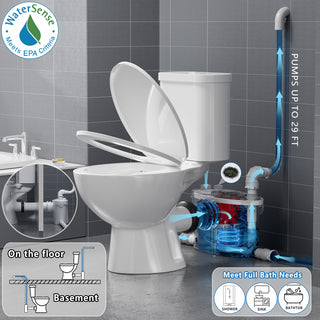
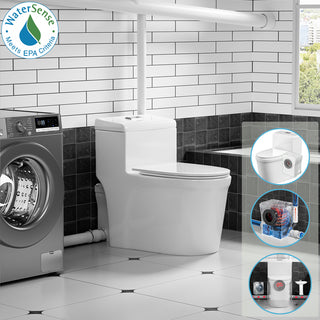

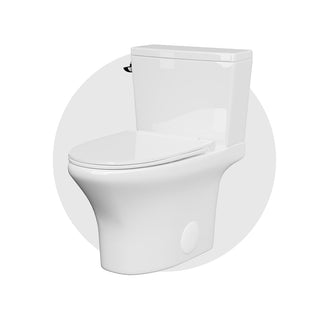



P-trap and S-trap toilets refer to two different drainage configurations. The “trap” in a toilet refers to the curved section that creates a water seal, preventing sewer gases from coming back into your bathroom — and choosing the right one is essential for ensuring your toilet fits your existing plumbing system.
💬 I remember speaking with a customer who was ready to pick a toilet for his remodel. As I tried to understand whether he needed a floor-outlet or wall-outlet toilet to give him the right recommendation, he paused and said, “I’m actually not sure whether my home has a floor or wall drain.”
It’s a surprisingly common moment — and an important one. Your home’s drain location directly determines whether you need a P-trap or an S-trap toilet. Get it right, and installation is seamless. Get it wrong, and you might face costly returns or even plumbing modifications.
In this guide, we’ll break down the key differences between P-trap and S-trap toilets, compare their pros and cons, and help you choose the right option based on your home setup.
I. What Are S-Trap and P-Trap Toilets?
The difference between S-trap and P-trap toilets mainly lies in their shape and the direction of the waste outlet:
- S-trap toilets have a curved outlet shaped like an “S” that directs waste downward into the floor — this is known as a floor outlet.
- P-trap toilets have an outlet shaped like a “P” that channels waste horizontally into the wall — this is known as a wall outlet or rear outlet.
Here’s a simple way to visualize:
If your toilet’s waste pipe connects through the floor, it’s likely an S-trap model. If it connects through the wall behind, it’s likely a P-trap.


II. Key Differences Between P-Trap and S-Trap Toilets
Aside from the basic difference in drainage direction covered above, S-trap and P-trap toilets also differ in these two important aspects.
🧱 Rough-In Dimensions
- For S-trap toilets, the rough-in is typically 12 inches, which refers to the horizontal distance from the finished wall to the center of the floor drain. Some homes may have 10-inch or 14-inch floor rough-ins, especially in older constructions.
- For P-trap toilets, the rough-in is measured vertically — from the finished floor up to the center of the wall drain. This vertical distance usually ranges from 7 to 10 inches, depending on the plumbing layout.
📐 Compatibility and Space Usage
- S-trap toilets are more commonly found in homes with floor drainage systems, especially in older houses or buildings that have not been renovated. They are ideal when the floor outlet cannot be moved easily.
- P-trap toilets, on the other hand, are popular in modern homes and remodels with wall drainage systems. Their wall-mounted design or rear-outlet connection helps save floor space and create a cleaner, more contemporary look — making them a good fit for compact or minimalist bathrooms.
III. Which Trap Type Performs Better?
1. Flushing Power
Modern S-trap toilets benefit from a natural siphoning effect due to their design, which often results in stronger flushing power compared to many P-trap models. However, it’s worth noting that a well-designed P-trap toilet can also deliver powerful, reliable performance that fully meets everyday needs.
In fact, some S-trap toilets — such as the Simple Project 21 Inch Tall Toilets — score over 1000 grams on the MaP (Maximum Performance) flushing test, indicating excellent waste removal efficiency.
| Many users worry that the siphoning in S-trap toilets might break the water seal and allow odors to escape. However, modern designs include a refill tube that quickly restores the water seal after flushing, effectively preventing sewer gases from coming back into your bathroom.
2. Maintenance & Service Access
S-trap toilets have their waste outlet exposed at floor level, which makes common maintenance tasks — like reseating the toilet or replacing the wax ring — more straightforward.
Most floor-mounted P-trap toilets (such as ELEMAZ 19 inch rear-outlet models) also offer accessible installation and are relatively easy to maintain.
However, wall-hung toilets with concealed tanks and in-wall plumbing can complicate repairs. If a leak or blockage occurs behind the wall, accessing the hidden pipes or tank may require opening the wall, adding time and cost.
3. Installation Compatibility
S-trap toilets fit well in homes with existing floor-drain plumbing systems, which are especially common in older houses.
P-trap toilets are designed for homes with wall drainage and are popular in modern construction and renovations, especially where saving space or achieving a sleek look is a priority.
📜 IV. Are S-Trap Toilets Still Allowed?
There’s often confusion about S-trap toilets due to the old-fashioned S-trap pipe bend used in plumbing, which has been prohibited in many plumbing codes because it can cause siphoning issues and sewer gas leaks.

However, modern S-trap toilets are designed as a single molded unit featuring an internal trap and an automatic water refill system to maintain the water seal. They fully comply with current plumbing codes such as the International Plumbing Code (IPC) and Uniform Plumbing Code (UPC). As a result, these toilets are widely accepted and commonly used, especially in floor outlet plumbing systems.
According to Section 1002.3 of the International Plumbing Code (IPC) and Section 1004.1 of the Uniform Plumbing Code (UPC):
| “S-traps are on the list of prohibited plumbing traps”
IPC Section 909.2 clarifies:
| “Toilet trap assemblies are exempt from the prohibition on S-trap configurations”
⚖ V. Pros and Cons Summary
|
Feature |
S-Trap Toilet |
P-Trap Toilet |
| Compatibility |
Floor outlet; fits older homes |
Wall outlet; fits newer homes |
| Maintenance |
Waste outlet exposed, easy access |
Floor-mounted easy to maintain; wall-hung harder |
| Flushing Power |
Stronger due to siphoning effect |
Good flushing performance |
🏡 Final Verdict: S-Trap or P-Trap?
Both modern S-trap and P-trap toilets meet plumbing standards and deliver good performance when properly installed. The simplest and most cost-effective choice is to match the toilet to your existing drain setup:
- If your bathroom drain is in the floor, an S-trap toilet is usually the best fit.
- If your drain is in the wall, go with a P-trap toilet.
⚠ Switching between trap types generally requires significant plumbing work, including moving drain pipes, which can be expensive and disruptive. If you’re unsure about your drain type or which toilet fits best, consult a professional plumber or check your bathroom’s drain outlet location before purchasing.
🔎 FAQ
Q: How do I know if my toilet is S-trap or P-trap?
A: If the waste outlet goes into the floor, it's S-trap. If it goes into the wall, it's P-trap.
Q: Can I replace an S-trap toilet with a P-trap model?
A: Not without rerouting plumbing. It's best to match your existing drain type.
Q: Are S-trap toilets still allowed in the U.S.?
A: Yes. Modern S-trap toilets are code-compliant and safe for use with floor drains.