

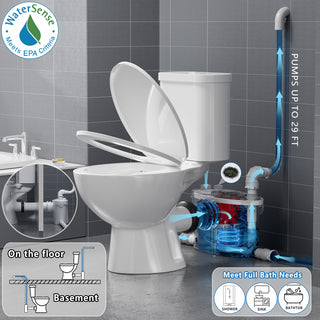
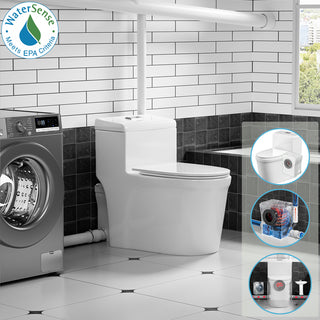

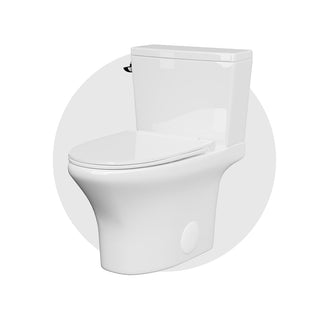
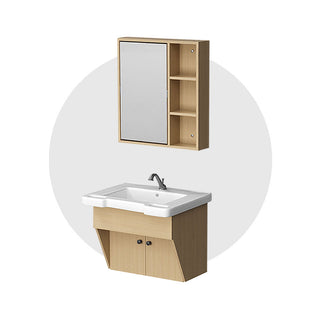




Top Toilet Sink Combo Benefits:
Save Space & Water
No room for a separate sink in your bathroom? I've walked dozens of customers through this exact problem — a powder room, a small rental, a basement build-out, a converted closet — where there's physically no space for a second fixture.

A toilet sink combo merges the toilet and handwashing basin into one fixture, so you get handwashing without needing a separate sink footprint. It also reuses that handwashing water to help fill the toilet tank, cutting down on fresh water use.
Those are the two benefits that actually matter. Everything else — installation cost, cleaning, layout flexibility — flows from those two. Let me walk you through both, with real customer situations I've handled myself.
1. Save Space: The Biggest Benefit of a Toilet Sink Combo
Here's what I tell every customer who calls me about a tight bathroom: fitting the toilet is rarely the hard part. The hard part is finding room for a sink, its plumbing connections, and enough clearance to actually move around both fixtures without banging your knees.
A traditional layout needs:
A toilet sink combo collapses that down to:

I see this pay off most often in powder rooms, half baths, basement bathrooms, apartments, and converted spaces — anywhere the floor plan just wasn't drawn with a second fixture in mind.
Real Customer Example: Three Small Apartments Without Room for a Separate Sink
A property owner in California reached out to me looking for a solution for three of her units. The bathrooms were tight, there was no plumbing run for a separate sink, and in a couple of units the half bath was too small to mount one on the wall at all.
She ended up ordering three toilets with built-in sinks. Here's what she told me afterward:
Her tenants were happy with them, and in those units, the combo unit is the only toilet they have. That's exactly the situation where I recommend this product — not when a separate sink is inconvenient, but when it genuinely doesn't fit.
Another Real-World Example: A 38-Inch-Wide by 28-Inch-Deep Bathroom
Another customer sent measurements for a very tight space just to the right of a doorway where the drain already existed:
- Room width: 38 inches
- Room depth: 28 inches
- Room height: 96 inches


The unit he was considering has an overall depth of approximately 28.7 inches, so it would extend slightly past the 28-inch depth. He confirmed the extra half-inch would not interfere with door swing or circulation and proceeded.
This exactly shows why a toilet sink combo can be especially useful in very compact bathrooms where every inch matters. When there isn't enough room to add a separate sink, combining the two functions into one fixture can make the available space far more practical.
Real Customers, Real Tiny Spaces
I hear versions of this constantly:
What jumps out to me in all of these isn't that the toilet itself is smaller — it's that customers can add handwashing without sacrificing additional floor or wall space to a second fixture.
Space Saving Isn't Just About Square Footage
When people think about bathroom space, they usually think about floor area first. But a separate sink also needs a workable wall location, its own plumbing connections, and clearance around it — none of which shows up if you're only measuring square feet.
That's why I point customers toward an integrated toilet sink when:
- A powder room is too narrow for a vanity
- A basement bathroom has limited plumbing options
- A converted closet has very little usable space
- A toilet room was originally designed only for the toilet
- A separate sink would interfere with the bathroom's circulation
- A remodel needs to add handwashing without reworking the existing layout
In other words, a toilet sink combo can turn a layout that looks impractical on paper into a bathroom that actually works — without adding another major fixture.
2. Save Water by Giving Handwashing Water a Second Use
A toilet sink combo can help reduce fresh water use by reusing handwashing water for toilet flushing. Instead of the water flowing directly down the drain after you wash your hands, it can be used to refill the toilet tank for the next flush, allowing the same water to serve two household purposes.
How Much Water Could That Add Up To?
The amount varies from household to household, but we can use a simple example to see how quickly small amounts of water can add up.
For a private bathroom faucet, the EPA WaterSense standard allows a maximum flow rate of 1.5 gallons per minute (GPM). A Michigan State University study cited by the EPA found that actual handwashing time averages approximately 7 seconds.
At 1.5 GPM, running the faucet for 7 seconds uses approximately:
So, one 7-second handwashing event would use approximately 0.175 gallons of water under this example.
If that water is reused through a toilet sink combo, the potential annual water reuse could look like this:
| Handwashing Events per Day | Potential Water Reused per Year* |
|---|---|
| 4 | ~256 gallons |
| 8 | ~511 gallons |
| 12 | ~767 gallons |
| 16 | ~1,022 gallons |
*Illustrative calculation based on a 1.5 GPM faucet and a 7-second handwashing duration. Actual water reuse will vary depending on faucet flow rate, handwashing habits, household size, toilet usage, and the specific plumbing design.
The numbers are only examples, but they illustrate the basic idea: a small amount of water reused each time can add up to hundreds of gallons over a year.
Over time, using less fresh water can also translate into real savings on your water bill.
Other Practical Benefits of a Toilet Sink Combo
Space and water are the reasons most customers buy, but there are a few side benefits I point out once they've decided the fixture fits their bathroom.
Less Separate Plumbing, Fewer Fixtures, Lower Installation Costs
When a bathroom doesn't need a separate sink, you're cutting fixture costs, materials, plumbing runs, and labor. I see this matter most on compact remodels or in spaces that were never designed to be a full bathroom in the first place.
Fewer Separate Surfaces to Clean
A standalone toilet and vanity give you two fixtures to clean, plus the surfaces and plumbing areas around each one. Combine them into one unit, and you've got one streamlined fixture instead of two separate cleaning zones.
A More Functional Small Bathroom
At the end of the day, this is the benefit that matters most: a room that might only have had space for a toilet can become a genuinely complete bathroom, with a dedicated place to wash your hands, and no need to carve out room for a conventional sink.
Final Thoughts: Why Choose a Toilet Sink Combo?
The biggest toilet sink combo benefits come down to two everyday problems: space and water. For a small bathroom, the integrated design gives you handwashing functionality without the footprint of a separate sink — and the customer projects above show how often that matters in real apartments, basements, and converted spaces.
The second benefit is water reuse. Giving handwashing water a second job reduces the fresh water your next flush needs. The exact gallons and dollars saved will vary by household, but even small amounts add up.
If you want to understand exactly how the sink and toilet share water, I'd point you to our complete guide: What Is a Toilet with Sink on Top? Definition & Working Principle. For current dimensions and specifications, see our Toilet with Sink on Top. And if you're mid-remodel and want to talk through whether a specific unit will fit your space, that's the kind of question I answer every day — feel free to reach out with your measurements.