




Macerator Toilet Guide · Product Expert
Can You Poop in a Macerator Toilet?
Yes — Here's Exactly How It Works
Every now and then, I get asked: can you actually poop in a macerator toilet? My first instinct is always to smile — yes, of course, that's what a toilet is for. But I've learned that for anyone encountering a macerating toilet for the first time, it's a completely fair thing to wonder. The whole system looks and works differently from a standard gravity toilet, so naturally people ask: does it handle solid waste? Can you flush toilet paper? How does the pump actually work?
In this article, I'll answer all of those questions directly — no fluff — so you can walk away with a clear, confident understanding of how to use a macerating toilet in everyday home life.
How a Macerator Toilet Handles Solid Waste
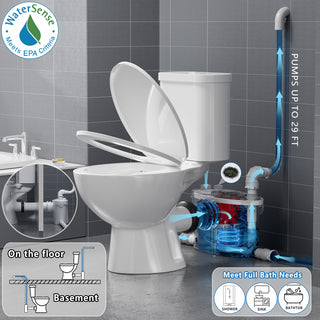
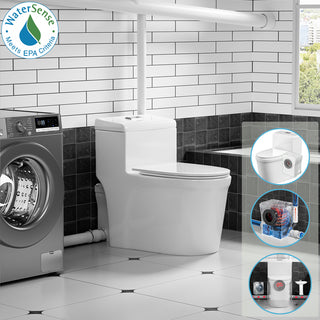
A macerating toilet works fundamentally differently from a traditional gravity-flush toilet. Instead of relying on a large-diameter drain pipe and a downward slope to carry waste away, a macerating toilet has a sealed pump unit — typically mounted directly behind the toilet — that does the heavy lifting.
Here's what happens the moment you flush: solid waste and water enter the macerator chamber. Inside, a set of cutting blades (or a macerating disc, depending on the model) grinds everything down into a fine slurry. The pump then pressurizes that slurry and pushes it out through a small-diameter pipe — typically ¾″ to 2″ — that can run:
- Horizontally (left or right along a wall)
- Vertically (upward or downward several feet to reach an existing drain line)
- A combination of both directions at once
This is exactly why macerating toilets work so well in basements, garages, and spaces where conventional plumbing isn't accessible — the pump overcomes gravity and distance that a standard toilet simply can't handle. If you want a deeper look at the internal mechanics, I'd recommend reading How the SNFLEX Macerator Works on our site.
Can You Flush Toilet Paper?
Yes — and this is one of the things I always emphasize when customers ask, because it surprises people. Standard toilet paper is completely fine.
Our SNFLEX macerating toilets are designed to handle normal quantities of standard septic-safe toilet paper. For the best long-term performance, I recommend sticking to:
- Standard 1-ply or 2-ply toilet paper
- Septic-safe or biodegradable varieties
- Moderate amounts per flush — don't stack up half a roll
- One use, one flush — don't save several sessions worth for a single flush
In practice, the experience is nearly identical to using a regular toilet. That's not marketing language — it's what thousands of customers who've made the switch have told us. Here are a few of their voices:
"This toilet system works perfectly, flushes great, and it solved all of our old problems with our basement lavatory. Our family is very happy with it. I would recommend it to everyone who has a basement washroom!!"
"These guys sent us a basement toilet that works well — it is connected to a sink, a shower, and a kitchen sink area plus the toilet. It is relatively quiet and the pump lifts the sewage up 4 feet to the house sewage line exit. Everything is working well so far and I can recommend this brand."
"I like the way it works. We reconstructed the garage into a studio and this toilet works so well. It destroys everything before flushing it into city pipes."
What You Should Never Flush
I tell every new customer the same thing: the rule is simple. Only human waste and toilet paper go in. Everything else stays out.
The following items do not break down the way toilet paper does. Putting them through the macerator will wear down the blades, clog the discharge line, and shorten the life of the pump significantly:
- Flushable wipes or wet wipes (they are not actually flushable — the name is misleading)
- Paper towels or facial tissues
- Feminine hygiene products
- Dental floss
- Cotton balls or makeup pads
- Thick cleaning wipes
- Cat litter
- Food scraps or grease
Stick to that rule and you'll have very few problems. I've seen the macerators that come back with issues — almost every single time, it traces back to something on that list.
One note on bidets: adding a bidet seat to a macerating toilet is perfectly fine — it connects to the water supply, not the macerator, so it has no negative effect on how the pump operates. See the full bidet compatibility section below for installation details.
How Long Does the Pump Cycle Last?
This is one of the most common "is something wrong?" calls I get. A customer flushes, the pump runs for a few seconds and shuts off — then immediately kicks back on again. They're convinced it's broken.
In the vast majority of cases, it's not. Here's what's actually happening: when you flush, water entering the macerator chamber triggers a float switch that activates the pump. The pump moves water out until the float drops below the trigger point and shuts off. But one flush produces more water than the pump can fully clear in a single pass — so it cycles back on once or twice more to finish the job. Three to four short cycles per flush is standard behavior across most macerating systems, including the SNFLEX.
The only time I'd look more carefully is if the cycling seems excessive (more than 7–8 times) or if the pump never fully stops. In those cases, it's worth checking that the check valve was properly installed — a missing check valve is the one legitimate hardware issue I troubleshoot most.
One more thing people ask: is there a time limit for how long you can sit on a macerating toilet? No — there is no time limit. The macerator pump only activates when you flush. How long you spend in the bathroom has zero effect on the unit.
How Long Does a Macerating Toilet Last?
For a household that uses it regularly and takes basic care of it, a quality macerating toilet can last 10 to 15 years. The pump is the heart of the system — keep it happy and the rest follows. Here are the habits that make the biggest difference:
When Does a Macerating Toilet Make the Most Sense?
I've helped customers across all kinds of projects — and the situations where a macerating toilet consistently outperforms conventional options are pretty consistent. Here's where I see it make the biggest impact:
- Basement bathrooms: No gravity drain below the slab? A macerating toilet solves it without jackhammering the floor.
- Garage and workshop conversions: Adding a bathroom where no drain plumbing exists — the macerator creates the connection without a full excavation.
- Guest half-bath additions: Adding a second toilet to a main floor without ripping open walls or floors.
- Older homes and rental properties: Renovating spaces where the existing drain layout makes conventional plumbing expensive or disruptive.
- Any space far from existing plumbing: The small-diameter discharge pipe can run horizontally over long distances, making locations feasible that conventional plumbing can't reach economically.
The cost savings are real. Here's what actual customers have said:
"Real easy setup. Had a shed that had a sewage connection but was about 10 feet shy of where I wanted the toilet. Had plumbers come tell me they could install a regular toilet for $5,000–$8,000. Found this toilet and saved myself a little over $4,000."
"I had two different plumbing companies tell me I would not be able to put a bathroom in this garage addition due to excavation costs. This toilet changed the game. My plumber knew how to install it and it was very easy to connect the shower, bathtub, and dual vanity sinks to it. This toilet saved me thousands of dollars."
Can You Add a Bidet to a Macerating Toilet?
Yes, and I get this question more often now that bidet seats have become popular. You install a bidet on a macerating toilet exactly the same way you would on any other toilet — it connects to the water supply, not the macerator, so there's no interference with the pump.
A few things to confirm before you buy a specific bidet model:
- Bolt hole spacing — on the SNFLEX two-piece macerating toilet, the seat bolt holes are approximately 6 inches apart. Many bidet seats have adjustable brackets that cover most standard spacings.
- Water inlet compatibility — all SimpleProjectUS toilets use a standard ⅞″ or ½″ water inlet. Check your bidet's inlet hose diameter and your shutoff valve. Most bidet kits include the T-adapter.
- Seat height — adding a bidet seat raises the seat height slightly (typically ~0.5″). Worth noting if you're working with ADA height requirements.
- Control panel clearance — make sure your bathroom layout has enough wall or side clearance for the bidet's control panel.
Frequently Asked Questions